
Search is evolving at a breakneck pace. With the rise of voice assistants, AI chatbots, and Google’s AI-powered results, Answer Engine Optimization (AEO) has emerged as the latest buzzword in digital marketing. Small business owners, e-commerce entrepreneurs, and marketers are asking a pressing question: Is AEO replacing traditional SEO? In this comprehensive guide, we’ll explore what AEO is, how it differs from classic SEO, and why it’s becoming increasingly important. We’ll also examine current industry trends, expert opinions, and real-world examples to illuminate this evolution.
Most importantly, you’ll learn why traditional SEO techniques – from on-page content tweaks to technical site fixes – remain as relevant as ever, and how AEO and SEO can work hand-in-hand. The goal is to inform and empower you, so you can adapt your strategy and make the most of both approaches (and know when to call in Professional SEO Services to help). Let’s dive in.
What is Answer Engine Optimization (AEO)?
Answer Engine Optimization (AEO) is optimizing your content so that search engines and AI-driven platforms can directly extract and display the answer to a user’s query. In other words, AEO aims to get your information featured in places like voice assistant responses, featured snippets, or AI-generated summaries, which are the results where users get instant answers without clicking a link. According to one definition, AEO is about structuring your content to be “easily understood and surfaced by AI-driven search features like voice assistants, AI summaries, and featured snippets”. The focus is on clarity, directness, and relevance, so algorithms deem your content the best answer for a given question.
Think about the last time you asked Siri or Alexa a question or saw Google answer a query at the top of the results page. The technology providing those immediate answers – whether it’s an AI chatbot like ChatGPT or a virtual assistant – acts as an “answer engine.” AEO is all about optimizing for those answer engines. That means ensuring your content is accurate, helpful, and formatted so that these systems can easily interpret and present it. It’s a shift from the traditional SEO mindset of ranking a webpage toward becoming the answer itself.
This concept has gained prominence in recent years alongside the explosion of AI in search. As Neil Patel, a well-known digital marketing expert, explains, the term comes from the fact that modern AI technologies (like ChatGPT, Bard, and voice assistants) are essentially “answer engines” – they skip the list of links and give you a direct reply. With AI-driven search results, only one immediate answer is often shown to the user. AEO is about making sure that one answer comes from your content.
Traditional SEO vs. AEO: Key Differences
At first glance, AEO might sound like SEO with a new name. They indeed share many of the same foundations, but traditional Search Engine Optimization (SEO) and Answer Engine Optimization (AEO) differ in their goals and tactics. Here’s how they stack up:
- Objective – Clicks vs. Answers: Traditional SEO is designed to drive traffic to your website. The goal is to rank high on search engine results pages (SERPs) for specific keywords and earn that click-through to your site. AEO, on the other hand, is about visibility within the answer itself, not necessarily driving a click. It prioritizes getting your brand or content featured directly in the search result (like in a snippet or voice answer), even if the user never visits your site. In other words, SEO wants the user to click your link, whereas AEO is satisfied if the user sees or hears your information immediately.
- Content Format: In SEO, you might create in-depth blog posts or product pages optimized with keywords to engage readers over several minutes. AEO requires a different approach – concise, structured, and precise content that an AI can grab and display in seconds. It’s about delivering the bite-sized answer upfront. For example, a traditional SEO piece might be a comprehensive article on “best running shoes,” aiming to rank and get clicks. In contrast, an AEO-focused piece might ensure the article has a clear, one-paragraph answer for “What are the best running shoes for flat feet?” at the top. AEO content often mirrors natural language questions (the way people ask things) and provides a direct response immediately.
- User Experience vs. Machine Readability: SEO has long been about both pleasing the user and the search engine – using keywords, meta tags, and link structures so Google can index your page, while also providing value so users stay and convert. AEO leans even more into machine readability: content must be formatted so AI algorithms can easily parse it. That means explicitly telling the search engine what your content means by using question-and-answer headings, bullet points, step-by-step lists, and schema markup (structured data). If information is buried in a wall of text, an answer engine might miss it. AEO is about making answers stand out in the content structure (using clear headings, tables, FAQ sections, etc.) so a machine can quickly find and present them.
- Platform Focus: Traditional SEO primarily targets search engines like Google, Bing, or DuckDuckGo – the “ten blue links” scenario. AEO targets answer platforms and features: voice assistants (Siri, Alexa, Google Assistant), AI chatbots (ChatGPT, Bing Chat, Google’s Bard/Gemini), and special SERP features like Featured Snippets, Knowledge Panels, People Also Ask boxes, and AI-generated answer summaries. As a result, keyword targeting differs: SEO often targets short phrases or keywords (“best restaurants in Iceland”), whereas AEO content is geared toward the conversational queries users might speak or input to AI (“what are some good restaurants in Iceland?”).
- Success Metrics: In SEO, you measure success by metrics like rankings, organic traffic, click-through rate, impressions, and conversions from search. AEO success is trickier to measure (as we’ll note later). Still, key indicators include your content being mentioned or cited by an AI (for example, getting a shout-out in a Bing Chat answer), appearing as a featured snippet or answer card, voice assistant referrals, and, ultimately, any referral traffic or conversions that come from those answer-rich platforms. AEO might also track something like “placements” – where your brand appears in an answer, even if no direct click is recorded. This shows how the focus shifts from pure traffic to overall visibility and brand presence.
- Click vs. No-Click Paradigm: The most significant philosophical difference is that SEO traditionally depends on clicks, while AEO is comfortable with the zero-click search. In AEO, the user’s journey might end on the search results page or in the voice answer – they got what they needed. Traditional SEO has always wanted users to click to your site for the full answer or experience. As Carson Crane, Senior SEO Strategist at AgencyAnalytics, puts it: “SEO still depends on earning that click and guiding users through a full-page experience, whereas AEO is about being the answer, right in the search result, summary card, or voice reply.” In other words, AEO is about position zero (becoming the answer), while SEO is about ranking #1 and beyond.
It’s important to note that AEO isn’t a replacement for SEO or an evolution or specialization. Most AEO techniques are built on traditional SEO best practices. You still need great content, you still need to optimize keywords (especially question keywords), and you still need authority (links and credibility) for your answers to be chosen. AEO shifts the emphasis to how the content is delivered. As Neil Patel explains, AEO uses many ranking factors as SEO – like using relevant keywords, good site structure, backlinks, and schema markup – but with the more direct goal of answering the user’s question in a format that can be instantly displayed. The table might have turned, but the legs that support it (your on-page, off-page, and technical groundwork) are the same.
Why AEO Is Becoming More Important in 2025
You might think: “This sounds interesting, but do I need to worry about AEO right now?” The short answer is yes – and here’s why. Several converging trends in 2024 and 2025 have dramatically changed how people search and search engines display results. These trends explain why AEO has moved from a niche concept to a central consideration in SEO strategies today:
- The Rise of AI-Powered Search: In the past year, AI-driven search features have gone from experimental to mainstream. Google is rolling out its Search Generative Experience (SGE) – AI summaries at the top of search results – and Microsoft’s Bing has integrated an AI “Copilot” (powered by ChatGPT) into its search. These AI results are no longer just a novelty; they’re becoming the default way people get answers. AI tools like Google’s SGE, Bing’s AI chat, and ChatGPT are now key to how users search for information. To give a sense of scale, over 400 million people use OpenAI’s ChatGPT products each week, and Bing’s mobile app saw downloads grow 4× after integrating AI. That’s a massive user shift toward AI-assisted answers. If these answer engines are where users are looking, you want your content to show up there, and that’s what AEO is about.
- Users Expect Instant Answers: Today’s internet users are increasingly impatient. Instead of clicking through multiple links and reading long articles, many prefer to scan for a quick answer and move on. Google’s data shows an ever-growing prevalence of “zero-click searches“ – queries where users don’t click any result because they found what they needed on the results page. By 2024, nearly 60% of Google searches ended without a click. More than half of searches are resolved by featured snippets, knowledge panels, or other direct answers. This trend is only growing. From definitions to how-to steps to simple facts, they will if people can get the answer in seconds. AEO matters because the strategy gets your information into those coveted answer spots. It’s how you ensure your content is the one providing that instant gratification.
- Shrinking Organic “Real Estate“ on SERPs: Visit a Google results page today, and you’ll notice the top is crowded with non-traditional elements: answer boxes, “People Also Ask“ dropdowns, local map packs, shopping carousels, and more. These features further push the classic organic links down (often below the fold on mobile). With AI summaries joining the mix, the space for a plain old blue link at the top is smaller than ever. Even if you rank #1 organically, you might appear halfway down the page after all the answer-oriented content. For example, Google’s new AI Overview can appear above everything, giving a synthesized answer from multiple sources. Being part of those answer-focused features is increasingly key to visibility. It could be overlooked entirely if your content isn’t optimized to be pulled into a snippet or an AI overview. AEO helps you claim some of that prime real estate in an answer-dominated results page.
- Changing Search Behavior (Voice & Conversational Queries): The way people search is changing, not just in impatience, but in format. Voice search is a prime example – instead of typing a keyword, people ask full questions to their phones or smart speakers. By 2025, about 20% of internet users worldwide will actively use voice search regularly, and the number of voice assistants in use (like Siri, Alexa, Google Assistant) will have exploded to over 8 billion devices globally. These voice queries tend to be more natural language (“Hey Google, what’s the best pizza place near me?”) rather than stilted keyword phrases. Likewise, even text searches are becoming more conversational, especially with tools like Google’s Bard or Bing Chat, where you can ask follow-up questions. What this means is that optimizing for questions and natural language is crucial. AEO addresses explicitly that need – it centers your strategy on answering users’ questions. Content that directly answers conversational questions is more likely to be surfaced by voice assistants and AI chats. Interestingly, voice assistants often pull their responses from featured snippets (a.k.a. position zero) on Google. If your site is optimized to capture featured snippets, it’s suitable for web results and can also make you the voice answer that Siri or Alexa recites to the user. In short, the more people talk to their devices, the more you need AEO.
- The Zero-Click & Multi-Platform Reality: AEO’s rise also reflects a broader digital marketing reality: users might discover and engage with your brand without visiting your website, through what some call “search everywhere optimization”. They might see your content in a Google snippet, hear about you from Alexa, or find you via a chatbot. For instance, Gartner predicts that 25% of organic traffic will shift to AI chatbots and virtual assistants by 2026. Already, we’re seeing signs of this shift. A well-known Q&A site, Stack Overflow, experienced a 14% drop in visits in March 2023 and an 18% drop in April 2023, right after ChatGPT’s launch – users got programming answers from AI instead of visiting the forum. Some businesses report an interesting trend: their traffic might be down, but sales are up. One case cited that NerdWallet’s website traffic dropped 20% while its revenue grew 35% in 2024. This suggests users are still finding what they need (and converting), but perhaps not through the old path of clicking through lots of organic search results. They might glean info from snippets or AI answers and make purchase decisions offline or via direct methods. The takeaway: visibility matters as much as, if not more than, clicks. Being present in the answers means staying on the radar of potential customers, even if the traditional traffic metrics don’t tell the whole story. AEO is a response to this zero-click, multi-platform search landscape – it’s about showing up wherever searches happen, not just on your site.
All these trends underline one thing: the search landscape 2025 is very different from 5 or 10 years ago. Traditional SEO – optimizing for blue links – is no longer sufficient on its own to maintain visibility. This doesn’t mean SEO is dead (far from it, as we’ll discuss), but it means SEO has to broaden its scope. As Carson Crane noted, this is the first time Google’s dominance is being truly challenged – search visibility now means “using traditional SEO as the foundation, while prioritizing AEO to stay visible across multiple AI-driven and generative search platforms.“ In plain terms, you still need to rank on Google, but you must also be the answer on Siri, Alexa, ChatGPT, Bing, and whatever comes next.
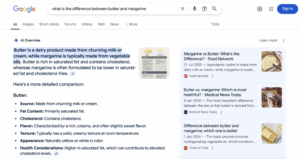 An example of Google’s AI Overview answer (highlighted in blue) directly addresses a user’s question. In this case, the query “what is the difference between butter and margarine“ triggers an instant, detailed answer at the top of the search results. This kind of AI-generated answer summary illustrates how search engines present information directly on the SERP. AEO strategies aim to have your content featured in such answers via Google’s AI, featured snippets, or voice assistant responses. It shows the evolving landscape where providing concise, authoritative answers can make your brand visible even if the user doesn’t click through to a website.
Expert Insights: “Is AEO the New SEO?”
The buzz around AEO has led some in the industry to declare it “the new SEO.“ While that phrase grabs attention, experts generally clarify that AEO isn’t replacing traditional SEO. Instead, it’s a response to new technology and user behavior built on the core principles of SEO. Let’s look at a few expert opinions to frame this:
- AEO as an Evolution, Not a Revolution: SEO veterans often describe AEO as a natural evolution of search optimization. Neil Patel, for instance, views AEO as a subset of SEO, sharing the same end goal of providing helpful content to users, but taking a more specialized route to get there. He notes that search engines use hundreds of factors for rankings (keywords, site structure, links, etc.), and AEO leverages many of those same factors. The difference is that AEO “has a more direct goal: to answer the question posed by the user”. In practice, this means content geared for AEO must be easily readable, crawlable, and presentable in a direct answer format. Unlike a traditional search, which offers a list of options, Patel emphasizes that an answer engine often provides only one answer. Hence, you need to position your content as the one best answer. The takeaway from this expert view is that SEO and AEO are intertwined. If you’re already doing good SEO (authentic content, keyword research, link building), you have the ingredients for AEO – you need to tweak how you serve the content.
- “The New SEO“ – Embracing the Change: Some experts boldly state that “AEO is the new SEO”, highlighting just how significant this shift is. For example, Ethan Smith (CEO of Graphite) points out that AI chat interfaces like ChatGPT, Perplexity, and Google’s upcoming Gemini are converging with search, meaning brands must optimize for these answer-focused platforms just as diligently as they did for Google search in the past. In his view, strategies must adapt to target clusters of questions, not just single keywords, because an AI answer might draw from a broader understanding of a topic. While saying AEO “is the new SEO“ might sound like abandoning old methods, it implies that the skillset of SEO is expanding. SEO professionals are now SEO (Search Engine Optimization) specialists and AEO specialists – optimizing content for an AI to read aloud or summarize. This sentiment urges businesses to “ditch SEO as you know it“ (as one LinkedIn discussion with industry experts suggested) and re-imagine it in the context of AI and answer engines. It’s a call to be proactive: early adopters of AEO tactics could gain an edge, much like early adopters of mobile-friendly design or HTTPS did in earlier SEO eras.
- Data Point – Users Love AI Answers: Supporting the above, there are surveys indicating users’ attitudes toward AI-driven search. One report found that 76% of users prefer AI-enhanced search engines for handling detailed questions. This suggests that when people have complex or specific queries, most would rather get an AI-curated answer than sift through multiple web pages. That’s a significant user preference leaning towards the kinds of results AEO targets. Experts see this as validation that optimizing for answer engines meets a genuine user desire. However, the same expert commentary also notes that traditional tactics still matter – those AI-driven platforms often rely on the content created for conventional search to generate answers. In other words, users might love the convenience of an AI answer, but that answer still has to come from somewhere, usually a high-quality website. If that website is yours, you’ve won – if it’s your competitor’s, you’ve lost an opportunity. Thus, the expert consensus is that AEO and SEO are complementary. One industry writer succinctly said, “AEO doesn’t completely replace SEO. Traditional SEO tactics still carry serious weight… AEO zeroes in on straightforward replies for voice searches and snippets, while SEO builds the stable presence behind the scenes.“ Both methods can – and should – coexist in your strategy.
- Case Study Insights: SEO agencies that have jumped on the AEO trend report promising results. For instance, the SEO.com agency shared that they’ve run hundreds of AEO campaigns and got client content cited in various answer engines – from DuckDuckGo’s instant answers to Microsoft’s Bing Copilot and even Google’s AI overviews. Industries ranging from SaaS to utilities to professional services saw their content pulled into AI answers, tangible proof that AEO efforts can pay off. The experts behind those campaigns argue that this kind of visibility is valuable not just for the organic reach but also prepares businesses for future advertising opportunities in AI (imagine if chatbots start offering sponsored answers, for example).
All these insights drive home a clear message from the experts: AEO is here to stay, but it builds on SEO’s foundation. The most brilliant move isn’t choosing one over the other, but integrating AEO into your SEO game plan. In the following sections, we’ll examine how to do that and why you shouldn’t abandon traditional SEO tactics while pursuing answer optimization.
AEO in Action: Examples and Case Studies
It’s one thing to talk about concepts; it’s another to see how AEO plays out in real scenarios. Let’s explore a few examples and case studies that illustrate the impact of Answer Engine Optimization in the real world:
- Featured Snippet = Voice Answer: Consider a local business example. If someone asks their Google Assistant, “What’s the best café in downtown Seattle?”, the assistant might respond with something like, “According to Yelp, the best café is X, rated 4.5 stars, known for its artisan coffee… etc.“ Where did this answer come from? Often, it’s pulling from a Featured Snippet or a top local result on Google. If Yelp or a local blog had a featured snippet for “best café in downtown Seattle,“ that content would become the spoken answer. For the business X, having their name mentioned in that Snippet is invaluable – it’s essentially a recommendation delivered straight to the user without visiting any website. This demonstrates AEO: the content was optimized to answer a specific question (likely via a list of top cafés in an article or via a well-optimized Google My Business listing + reviews) and was rewarded by being the answer. Numerous studies have shown that voice assistants often draw on featured snippet content to answer questions. So, if your site can capture those snippets (position zero in SERPs), you’re not just winning a web search – you’re potentially winning voice searches too.
- Traffic Down, Revenue Up – A New Pattern: A particularly eye-opening case is that of NerdWallet, a finance website. As mentioned earlier, NerdWallet saw a notable drop in organic traffic (about 20% down) in 2024, yet its revenue grew by over 35%. How is this possible? It appears that while fewer people were clicking through to their site (possibly due to more users getting quick answers via Google’s snippets or summaries for things like credit card rates, etc.), those who did come were highly qualified, or the brand presence built through all those answer boxes kept them top-of-mind for consumers who converted later. In essence, users might get their preliminary answers directly on Google (powered by NerdWallet’s content) and then come to NerdWallet or act on that information in a more targeted way. This case exemplifies a reality of AEO: even if the clicks drop, being the trusted answer source can still drive business outcomes. It’s a shift from “traffic is everything“ to “visibility and authority are everything.“ Your content can fulfill its purpose (answering and guiding the user), sometimes without the user spending a lot of time on your site. To capitalize, ensure that if a user only sees a snippet of your content, it’s high-impact and includes your brand voice or expertise so that you build credibility and trust.
- SEO Agency AEO Campaigns: SEO.com (an agency) reported several AEO campaign successes across industries. For example, a SaaS company’s content earned citations in DuckDuckGo’s instant answers and Microsoft’s AI-powered search results. A utility company got cited in Bing’s Copilot and an AI answer engine (Perplexity AI). A professional services firm’s content was published in Google’s AI-generated overview and Bing. These cases might not sound as flashy as “we increased traffic by X%,“ but they underscore a crucial point: AEO can get your brand in front of users on platforms where you otherwise have zero presence. DuckDuckGo, for instance, doesn’t have traditional SEO in the same way (it aggregates answers from sources like Wikipedia or uses its algorithms). But if it’s citing your content for an answer, that’s exposure you wouldn’t have had via Google rankings alone. Similarly, if Bing’s AI summarizes an answer and your site is listed as the source, you gain credibility. It’s a form of PR and expertise-building, delivered via AI. These case studies show that businesses investing in AEO are seeing their content pop up in these answer engines – and that’s a win for brand visibility.
- FAQ Pages & Knowledge Bases Paying Off: Another practical example comes from countless websites that have built robust FAQ pages or knowledge base articles. With the advent of AEO, those who did are reaping benefits. Suppose an e-commerce site has an FAQ page addressing “How do I track my order status?“ or “What is your return policy?“ If optimized well (question in the header, concise answer following, implementing FAQPage schema markup), Google might feature that Q&A on the search results when someone searches the question. Additionally, Google’s “People Also Ask“ boxes often pull from sites’ FAQ content. This means a potential customer could ask a question, get an immediate answer from your site in the SERP, and without even clicking, have a positive interaction with your brand (and possibly feel confident enough to make a purchase). Companies that anticipated user questions and answered them clearly on their site effectively practice AEO – even if they didn’t call it that – by capturing those answer opportunities. For readers of this blog, it’s worth auditing your own site’s FAQ content: Are you thoroughly answering the questions your customers commonly have? Are those answers easily scrapeable (e.g., one question = one answer text chunk)? If yes, you can appear in those People Also Ask and featured answer formats. If not, it might be time to beef up that section – it’s a classic SEO move now with AEO implications.
- Local Business with Structured Data – A Mini Case: Imagine a local restaurant that publishes a blog post titled “10 Best Family-Friendly Restaurants in [City]”. In the pre-AEO world, that blog post was purely an SEO play, aiming to rank when people search “family-friendly restaurants [City]”. In the AEO world, if that post is well-structured (perhaps each restaurant is an H2 with details, and a summary paragraph at top), Google might extract a snippet like “The best family-friendly restaurant in [City] is XYZ, known for its play area and kids menu…“ directly on the SERP. Additionally, if the site used Review Schema and other structured data for each restaurant listing, Google could show rich results (like star ratings) or even incorporate those into an AI summary. If that Snippet is spoken by a voice assistant for someone asking “Hey Google, what’s a good family restaurant in [City]?”, the user might hear “According to [Your Site Name], the best family-friendly restaurant is XYZ…”. This hypothetical scenario shows how combining traditional content strategy with some technical optimization (schema markup) leads to AEO success. In essence, the site acted as the answer engine, and Google relayed that answer to the user – a big win for that site’s authority.
These examples demonstrate that AEO is not just theory – it’s happening now. Whether through featured snippets, voice assistant answers, or AI chat citations, content creators are finding new ways to reach their audience. However, none of these successes happen by accident. They result from deliberate optimization and strategy, bringing us to our next point: how AEO and SEO efforts complement each other and what you can do to ride this wave.
The Ongoing Relevance of Traditional SEO (and How It Supports AEO)
With all the talk of answers and AI, is traditional SEO still worth the effort? The resounding answer from experts and case studies is “Yes.“ Conventional SEO practices remain relevant and critical because they lay the groundwork for AEO success. Here’s why the old pillars of SEO – content, keywords, backlinks, technical health – are as important as ever:
- Content Quality and Depth: Search and answer engines need reliable, accurate information. If you want to be the answer, your content must be better (authoritative, more explicit, and relevant) than everyone else’s. That hasn’t changed since the days of SEO 1.0. You still need to do thorough keyword research and understand user intent. AEO might require even deeper insight into intent, since you’re targeting specific questions. Investing in On-Page SEO Services – for example, optimizing title tags, headers, and body content for clarity and relevance – directly feeds AEO. When you format a blog post with proper headings or ensure each page has a clear meta description, you’re helping Google understand your content better. The AEO payoff: clear headings (especially phrased as questions) can get picked up as parts of an answer. So, on-page SEO optimizations are dual-purpose now – they improve your traditional ranking and your chances of being extracted for an answer snippet.
- Authority and Backlinks: Search algorithms still heavily rely on the concept of authority, roughly measured by the quality and quantity of backlinks (among other signals). It’s simple: the more authoritative your site, the more likely Google (or Bing, etc.) will feature your content in an answer box. Why? Because the search engine doesn’t want to present an answer from a dubious source. Building authority through Off Page SEO Services (e.g., a strong backlink strategy, digital PR, social signals) remains fundamental. When you secure high-quality backlinks to your content, you’re boosting its ranking potential and credibility for AI summarizers and voice assistants. Remember, answer engines often pull from “trusted sources”. If your site has a solid reputation, it’s more likely to be deemed trustworthy enough to quote. So, keep up your link-building efforts, guest posting, partnership outreach, and so on – those “off-page“ tactics also pay dividends in an answer-driven world.
- Technical SEO and Structure: AEO is about how content is structured and delivered. This is where Technical SEO Services come in. Ensuring your site is crawlable and indexable by search engines is step one – if Google can’t easily crawl your page due to poor technical setup, it won’t feature you in a snippet. Beyond the basics, technical SEO provides tools (like structured data) that speak directly to search engines. By implementing schema markup (such as FAQ schema, HowTo schema, etc.), you are giving search engines a roadmap to the answers on your page. For instance, the FAQPage schema wraps Q&A content in a machine-readable format that screams, “This is a question and here is its answer.“ Google can use that to show rich FAQ results or feed an AI answer. Likewise, marking up product info, reviews, and how-to steps can make your content eligible for rich results that often occupy that top-of-page answer space. Another technical aspect is site speed and mobile-friendliness: voice search, especially, is mobile primarily and on-the-go, so Google favors fast-loading, mobile-optimized pages for voice results. Technical SEO improvements (better page speed, clean code, responsive design) help ensure you’re in the running for those voice query answers. A fast site also means that if a user does click through after seeing an answer snippet, they won’t bounce due to slow load times, maintaining the positive impression.
- E-E-A-T and Trust: Google’s quality guidelines emphasize Experience, Expertise, Authoritativeness, and Trustworthiness (E-E-A-T). This concept carries into AEO as well. Answer engines are essentially distilling information – they need to trust that information. Suppose your site demonstrates expertise (say, a medical article written by a doctor and cited by other professionals). In that case, it’s more likely to be chosen as the basis for an answer in a health query. Maintaining high content standards, citing credible sources within your content, keeping information up-to-date – all classic SEO content guidelines – increases your E-E-A-T. High E-E-A-T pages are more likely to rank and to be used in snippets or AI summaries. For example, an answer engine will avoid an article that hedges facts or uses lots of “might“ and “could“ without certainty. If your content is confident and factual, it’s more snippet-worthy. This underscores the synergy: good SEO content is good AEO content.
- Keyword Strategy (Expanding to Questions): Traditional SEO keyword strategy focused on covering high-volume terms and their variations. That’s still important, but AEO also pushes you to research question keywords and long-tail conversational queries. Using tools (like AnswerThePublic, People Also Ask, etc.) to find the questions people ask around your topic is now an essential part of keyword research. It’s not separate from SEO; it’s an extension of it. Many SEO agencies and Professional SEO Services have started incorporating Q&A targeting into their content creation process. If you hire a modern SEO service, they’ll likely do keyword research that includes common questions and then create content sections to address those. When you invest in professional SEO help, you’re often indirectly investing in AEO, because the agency will ensure your site speaks the language of algorithms and humans asking questions.
In summary, traditional SEO is the foundation on which AEO is built. If you have been following best practices in SEO, you’re halfway to AEO already. What’s required is a shift in mindset: recognizing new search behaviors and tweaking your tactics to account for them. But the core work – quality content, solid site infrastructure, link authority – remains non-negotiable. Rather than view AEO and SEO as separate silos, think of AEO as the natural next step or additional layer of optimization that complements your ongoing SEO efforts.
How AEO and Traditional SEO Work Together (A Balanced Strategy)
Now that we’ve established the importance of both approaches, the key question is how to integrate AEO tactics into your overall SEO strategy. Fortunately, you don’t have to start from scratch – it’s about adjusting focus and adding new techniques to your marketing playbook. Here are some strategies for balancing AEO and SEO to get the best of both worlds:
- Incorporate Q&A in Your Content: Add frequently asked questions and concise answers to your pages. This could mean building an FAQ section on product pages, writing blog posts in a Q&A format, or simply ensuring each piece of content explicitly addresses common user queries. Use question-based headings (H2, H3 tags) for these questions – for example, a blog post about “Running Shoes“ might have an H2 that says “What are the best running shoes for flat feet?“ followed by a paragraph answer. This improves user experience (people love quick answers) and makes it easy for Google to snippet-ize that portion. Many sites now do this: you’ll notice blog articles with several Q&A pairs embedded. It directly responds to the AEO trend and doesn’t hurt SEO; it can improve dwell time and relevance.
- Optimize for Featured Snippets: There are known tactics to increase your chances of capturing featured snippets, such as prime AEO territory. These include: keeping answers brief (around 40-60 words) for paragraph snippets, using bulleted or numbered lists for “list“ style queries, and creating tables for data if appropriate. For example, if the query is “steps to do X”, answer it with a clear numbered list of steps. If the query is “best vs. worst of Y”, maybe present a comparison in a table or a bullet list. Structure your content such that the snippet answer is immediately after the question. Also, use the target query (or a very close variant) in the question header itself. Implementing these snippet-optimization techniques can significantly boost your visibility. As a bonus, when you win a featured snippet, you’re often simultaneously optimized for voice search answers (as we discussed).
- Leverage Schema Markup (Structured Data): This technical step yields rich results. Add relevant schema to your pages. FAQPage schema for Q&A content is a must if you have an FAQ section. If you have how-to guides, use the HowTo schema. You could use the Definition schema (though Google is good at pulling definitions without it, too). Structured data helps search engines understand your content context, increasing the chance that they will use it in an answer box or other enriched format. For local businesses, use the LocalBusiness schema on your site and keep your Google Business profile updated – voice assistants pull info from those sources for local queries. If this sounds too technical, engaging Technical SEO Services can help implement schema and back-end tweaks correctly, ensuring your site is technically primed for AEO opportunities.
- Continue Building Your Backlink Profile: Don’t focus solely on on-page tweaks. Off-page SEO (like link building and content promotion) remains a powerful driver for SEO and AEO. The more your content is referenced elsewhere (social media, other blogs, news articles), the more search engines see it as authoritative. High-authority content is the kind that ends up being featured. A well-rounded off-page SEO Services strategy might involve digital PR campaigns, influencer partnerships, or content marketing to earn backlinks. Think of it this way: you want your site to be seen as the authority on a topic. That way, your site stands out as a trusted candidate when an answer engine chooses which source to feature for a given question.
- Monitor and Adapt: As with any SEO strategy, you must measure results and adapt. AEO performance can be tricky to track (since not all answer appearances are reported clearly in Google Analytics), but you can gain some insights. Google Search Console now shows data on Google’s AI-generated answers (SGE) impressions and clicks (if any) – though currently, these may be rolled into normal search data. Some SEO tools are starting to track featured snippet rankings and even “People Also Ask“ presence. Keep an eye on these. If you notice certain pages frequently get featured snippets, analyze why and apply those lessons elsewhere. If some high-ranking pages lose clicks due to snippets above them (zero-click scenario), consider editing those pages to become the Snippet or provide an even better answer. It’s an ongoing process. Also, please pay attention to new developments: search engines update how their answer features work (for example, Google might change how it displays an AI overview or introduce new types of rich answers). Staying informed via SEO news sources (Search Engine Journal, Search Engine Land, etc.) will help you adjust your tactics promptly.
- Use Professional Help if Needed: Let’s face it – the search landscape is more complex than ever. If you’re running a business, you might not have the time to micro-manage all these SEO vs AEO nuances. This is where Professional SEO Services can be invaluable. A good SEO agency or consultant stays on top of these trends and can craft a holistic strategy for you. They’ll ensure your On-Page SEO Services include AEO-friendly content structuring, your Off-Page SEO Services build the authority you need, and your Technical SEO Services implement all the schema, site speed, and mobile optimizations to keep you competitive. Essentially, they can do the heavy lifting of integration, so you can focus on running your business. Partnering with professionals can accelerate your adaptation to the new search environment and help you avoid costly trial-and-error.
Balancing the above strategies creates a synergy between AEO and SEO efforts. For instance, focusing on conversational keywords (AEO angle) doesn’t detract from your core keywords – it enhances your content’s relevance. Optimizing for snippets doesn’t just potentially win you the Snippet; it often improves the clarity of your content overall (which can boost regular rankings, too). Using schema might not directly improve your traditional ranking, but it can give you a leap in visibility through rich results. It’s genuinely a win-win to combine these approaches.
Final Thoughts: Embracing the Future of SEO with AEO
So, is AEO replacing traditional SEO? Based on everything we’ve explored, AEO is not replacing SEO but augmenting and redefining it. The fundamentals of SEO – creating valuable content, optimizing site performance, and building credibility – remain indispensable. What’s changing is the context in which those fundamentals operate. Search has expanded beyond the classic browser results page. It now encompasses voice queries in your kitchen, AI chatbot answers on your laptop, and rich snippets on your phone’s search results. In this new context, Answer Engine Optimization is the strategy that ensures your SEO efforts extend their reach into every corner of search.
The key takeaway for small business owners, e-commerce site operators, and marketers is this: don’t abandon traditional SEO techniques, but don’t ignore the rise of answer-focused search either. The most successful digital strategies in the future will be those that blend both. Think of traditional SEO as the cake and AEO as the icing – without the cake (strong content, site, links), the icing won’t stick; but with no icing, you might not look as appealing in the current landscape.
Practically speaking, start by assessing your current content through an AEO lens. Are you directly answering the questions your target audience is asking? If not, weave those answers in. Next, fortify your site’s authority and technical health, because those give you the platform to be featured as an answer. Keep an eye on your analytics and search console for changes – you might find, for example, that even as traffic from inevitable queries dips, your sales or leads remain steady (or even grow) because people got what they needed faster. That’s not necessarily bad; it could mean your on-site conversion improved or your brand resonated via those answers.
In this fast-changing SEO environment, staying informed is half the battle. The other half is execution. If you feel overwhelmed, remember that resources and Professional SEO Services are available to help guide you. Many SEO professionals have already shifted to include AEO in their playbooks. Whether it’s optimizing on-page content, adjusting off-page strategies, or tweaking the technical underpinnings of your site, an experienced SEO team can ensure you’re covered on all fronts – traditional and new. The goal is to keep your business visible, relevant, and competitive no matter how users search.
In conclusion, AEO isn’t the end of SEO – it’s an exciting new chapter. By embracing Answer Engine Optimization alongside your established SEO efforts, you position your brand to capture today’s search opportunities and whatever comes next. It’s about being proactive and user-centric: meeting your customers where they are searching and giving them what they need, as quickly and clearly as possible. Do that, and whether the search leads to a click or not, you’ve won half the battle – you’ve earned the user’s attention and trust. And in marketing, that’s ultimately what leads to conversions and success.
Now is the time to adapt and innovate. Use the insights from this guide to audit your content strategy, implement those Q&As, talk to your SEO team, and sharpen your approach. Combining the best of traditional SEO with cutting-edge AEO tactics will enable you to thrive in the era of answer engines. Here’s to your search visibility – may your business be the answer that everyone is looking for!